Learn to vibe code.
Ship a real app.
From "what is code?" to a live, secure, paid app, built with Claude in 30 days.
Ship Like Crazy is a vibe coding course for complete beginners. Follow Jo, who has never written code, building an ordering app for Aunt Meera's chai café before the Diwali rush. You build it too, on your own laptop, with Claude.
Chapters 1–3 are free. No account needed to start.
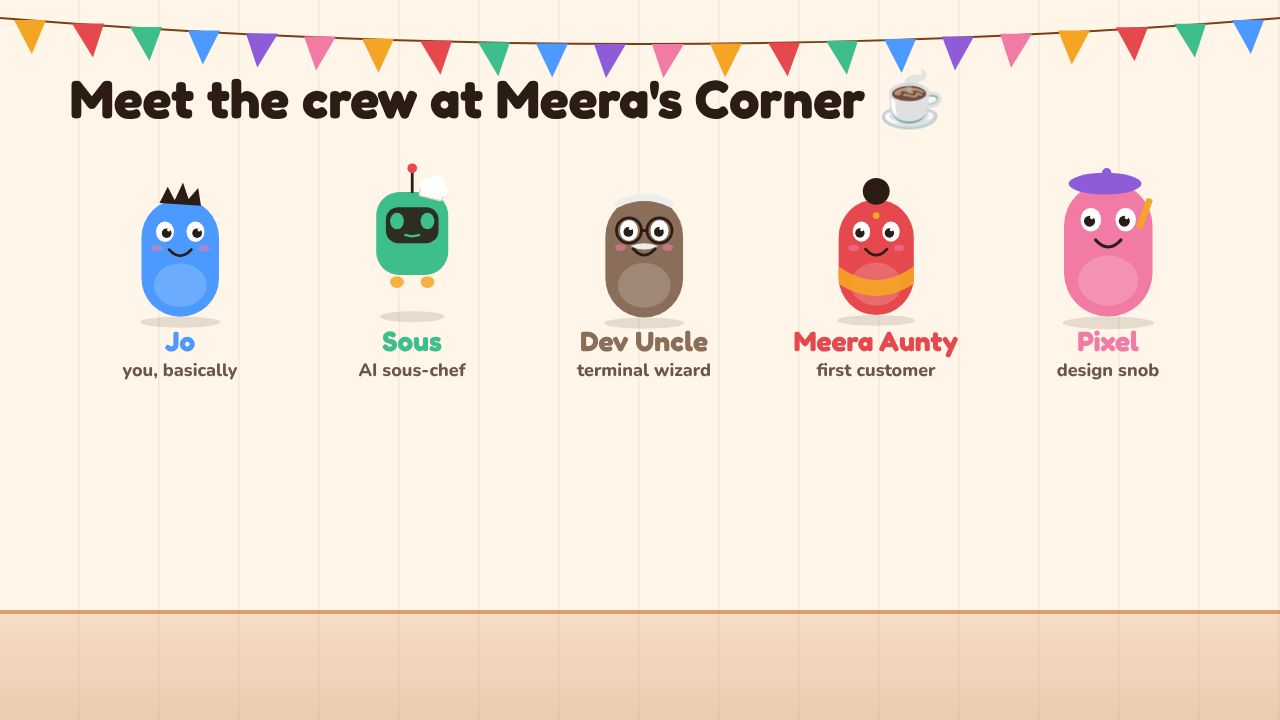
The ten characters of Meera's Corner pop in with their names and roles: Jo, Sous, Dev Uncle, Meera Aunty, Pixel, Chef Ravi, Tiku, Gita, Omar and Vex.
By the last page, you'll have
A live, paid app
QueueLess: pre-orders, loyalty points, Stripe payments and a kitchen board, on your own domain.
Files you own
A spec, a design system, a CLAUDE.md and a Git repo. The habits that make AI build what you meant.
Real judgement
Enough about UIs, servers, APIs, auth and databases to check the AI's work instead of trusting it blindly.
How every chapter works
- 🎬1. Scene
A short story moment sets up the day's problem.
- 📚2. Learn
The concept, explained through the café, with animations.
- 🛠️3. Lab
Step-by-step on your own laptop. Tick each step off.
- 🎮4. Play
28 mini-games make the hard ideas click.
- 🏅5. Checkpoint
A quick quiz, then claim your badge.
What's inside
Part I · The new way to build
Meet Sous, set up a real machine, ship a first page.
Part II · How software fits together
UI, servers, APIs, and the security lessons Vex teaches the hard way.
- 03The Dining RoomFreeWhat a UI is: websites, web apps, mobile and watch
- 04Chef Ravi's KitchenServers and services, and why the kitchen sits behind a wall
- 05Tiku Takes OrdersWhat APIs are: requests, responses, webhooks and MCP
- 06Gita at the DoorAuth, access control, and the security flaws of vibe-coded apps
Part III · Data
Databases, choosing a backend, and staying fast at 300 orders a minute.
Part IV · Building with Claude
The loop, the process, and the full QueueLess build.
Every concept has a face
Remember the person, remember the idea. The café is the map: Gita guards the door (auth), Pixel runs the dining room (UI), Tiku carries orders (APIs), Chef Ravi rules the kitchen (servers), and Omar keeps the pantry (databases).
“How hard can it be?”
“Yes chef! Wait, which chef?”
“Commit first. Thank me later.”
“Don't tell me features. Tell me how my mornings get easier.”
“If it looks like everything else, nobody remembers it.”
“Customers order. The kitchen decides.”
“Table 4, GET one masala chai, status 200!”
“Knowing your name isn't the same as owning table 7.”
“A pantry you can't search is just a pile.”
“Your login screen is lovely. Your database is wide open.”
Start free. Unlock the rest when you're hooked.
Free
₹0
- ✓ Start here + Chapters 1–3
- ✓ Their labs and mini-games
- ✓ Case studies and people to follow
Full book
₹1,499 one-time
- ✓ All 12 chapters and the finale
- ✓ All 28 games, labs and the full QueueLess build
- ✓ Progress synced to your account
- ✓ Prompt library, templates, future updates
Questions about vibe coding
What is vibe coding? +
Vibe coding means building software by describing what you want to an AI coding tool such as Claude Code, then reviewing and steering what it writes. Ship Like Crazy teaches you to do it well: to plan, check the AI's work, and ship something secure.
Do I need to know how to code to start? +
No. The book starts from "what is code?" and teaches the fundamentals you actually need (editor, terminal, Git, deploys) through a story and step-by-step labs on your own laptop.
What will I build? +
QueueLess, a real ordering app for a chai café, with sign-in, a database with row-level security, Stripe payments, loyalty points and a kitchen board, deployed on your own domain.
Which tools does the book use? +
Claude and Claude Code for building, VS Code or Cursor as the editor, Git and GitHub, Next.js for the app, Supabase for the database and sign-in, Stripe for payments, and Vercel for hosting.
Are vibe-coded apps secure? +
Often not by default. A whole chapter covers the most common security flaws in AI-built apps (missing row-level security, leaked keys, trusting the browser) and a pre-launch security ritual to check your own app.
How much does it cost? +
The first three chapters, case studies and people-to-follow list are free. The full book is ₹1,499 one-time, with every chapter, lab, game and future update.
How long does it take? +
It is designed as 30 evenings. Each chapter is one or two sittings, plus an optional mini-game or two.