Chapter 1. Meeting Sous
What vibe coding is, how LLMs write code, and the tools to start with
Chapter title card with the chapter's host character and the day of the countdown.
The family dinner
Sunday dinner at Meera Aunty's flat smells of rajma and worry. Downstairs, Meera's Corner, her chai café, has been quiet all week.
Everyone stops eating. Somebody's spoon clinks.
Later that night, back home, Jo opens a laptop and types into Claude: "Make a menu page for a chai café called Meera's Corner."
Forty seconds later there's a menu. Warm colours, prices, little steam icons. It's genuinely lovely. Jo stares at it for a while. Then a small robot in a chef's hat seems to bob up from the screen. That's how Jo will think of the AI from now on: Sous, the sous-chef.
That's vibe coding in one scene. Jo described what they wanted in plain English, and an AI built something real in seconds. It was also confidently wrong about something important. This chapter is about both halves of that.
- Explain what vibe coding is, and where it stops working
- Describe in one paragraph how an AI like Claude writes code
- Name the three families of vibe coding tools and pick one to start with
- Have your first proper working session with Claude, including fact-checking its work
What vibe coding actually is
In February 2025, the AI researcher Andrej Karpathy posted about a new way he'd been building software: describing what he wanted, letting the AI write it, and barely looking at the code. He called it vibe codingVibe codingBuilding software by describing what you want in plain language and letting an AI write, run and fix the code, while you steer by judging the result.. The name stuck so hard that Collins Dictionary made it their Word of the Year for 2025.
The meaning has stretched since then. Today "vibe coding" covers a whole range:
| Where you sit | What it looks like | Typical tools |
|---|---|---|
| Pure vibes | You chat; the tool builds and hosts the whole app. You rarely see code. | Lovable, Bolt.new, Base44, Replit |
| Guided vibes | You chat, but you read the plan, check the result and keep the code in your own repo. | Claude Code, Cursor |
| Agentic engineering | You direct AI agents like a tech lead: specs, tests, reviews. | Claude Code, Codex, Cursor |
Karpathy himself now calls the professional end of this range "agentic engineering". This book takes you from the first row to the middle one: you vibe the code, but you verify the result. By the end you'll be comfortable dipping into the third.
What vibe coding is great at
- Turning an idea into something clickable in an afternoon
- The boring, common parts of software: forms, layouts, logins, dashboards
- Explaining code you don't understand, line by line, as many times as you need
- Fixing errors when you paste the full error message back
Where it stops working (for now)
- Security. AI happily builds a login screen and forgets to lock the database behind it. Chapter 6 is entirely about this.
- Facts it can't know. Your aunt's menu, your company's pricing, a library released last month.
- Big, vague requests. "Build me Uber for chai" produces a pretty demo that falls apart. Small, clear steps work.
- Debugging its own mess. A popular joke from 2025 put it well: vibe coding is easy; vibe debugging is the hard part. Chapter 10 shows you how to get out of that loop.
How an AI writes code (no maths, promise)
You don't need to understand neural networks to vibe code. You do need a rough mental model, because it tells you when to trust the AI and when to check. Here it is in five steps.
1. Everything is tokens
An LLMLLM (large language model)An AI model trained on huge amounts of text and code that predicts the next piece of text. Claude is one. (large language model) reads and writes text in small chunks called tokensTokenA small chunk of text (a word or part of one) that a language model reads and predicts, one at a time.: a word, part of a word, a bracket, a space. "Masala chai" might be three tokens. A line of code might be fifteen.
2. It predicts the next token, over and over
Given everything so far, the model predicts which token most likely comes next. Then it adds that token and predicts again. A whole web page is just thousands of these predictions in a row.
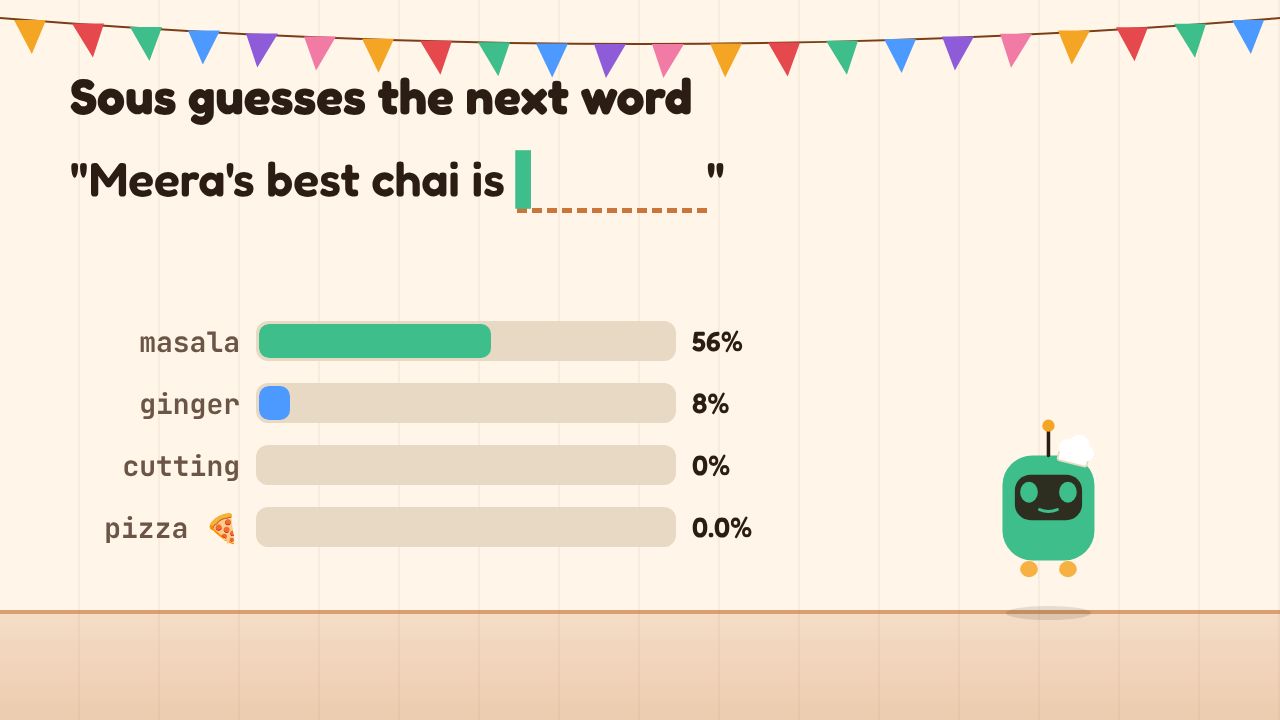
Sous completes the sentence 'Meera's best chai is…' with probability bars: masala 62%, ginger 21%, cutting 12%, pizza 0.3%. It picks masala, then adds 'with edible gold flakes', which is stamped MADE UP.
That's the whole trick, and it explains both the magic and the mistakes. "Masala" is very likely to be followed by "chai", so the model gets it right. "Meera's bestseller is…" has no true answer anywhere in its training, so it produces something plausible: a Saffron Rose Cold Brew.
3. It learned from enormous amounts of public code
Models like Claude learned from huge amounts of text and code. So common patterns (a login form, a pricing table, a database query) are easy for them. Rare or brand-new things (a library released last month, your company's internal tools) are where they guess.
Pick popular, boring tools: Next.js, Tailwind, Supabase, Stripe. The AI has seen them thousands of times and makes far fewer mistakes with them. Chapter 2 explains the stack this book uses.
4. It only knows what's in front of it
The model doesn't remember your project between conversations. It sees only its context windowContext windowEverything the model can see right now: your prompt, files it has read, its notes. It knows nothing about your project outside it.: your messages, files it has read, and any notes you've given it. That's why later chapters have you write a short spec file and a CLAUDE.md file. They're how you give Sous a memory.
5. Agents loop until it works
A chat model answers once. An agentAgentAn AI that loops: plan, use a tool (read a file, run a command), look at the result, decide the next step, until the job is done. keeps going: it makes a plan, takes an action with a tool (reads a file, runs a command, opens a browser), observes the result, and fixes what's wrong. Then it loops. Claude Code is an agent. This loop is why modern AI can fix its own errors, not just make them.
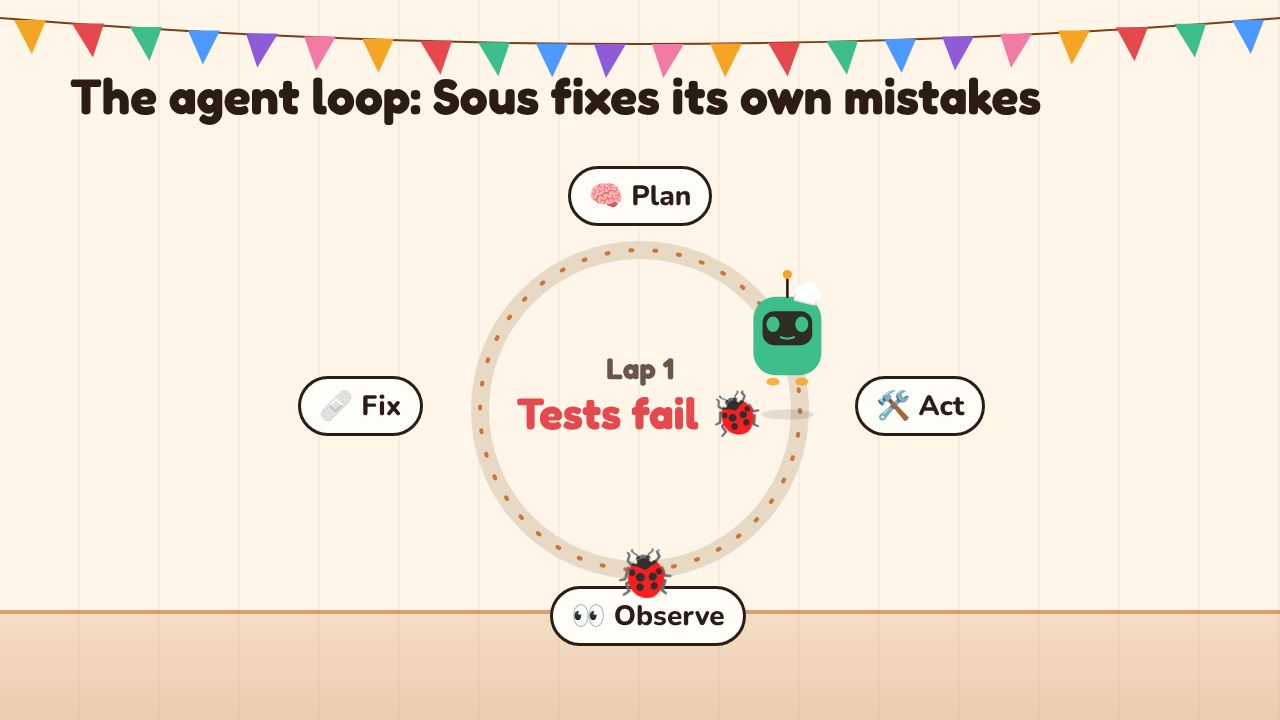
Sous circles a loop of four steps, Plan, Act, Observe and Fix. Tests fail on laps one and two; a bug is squashed; on lap three tests pass.
Because it predicts plausible text, not true text. It doesn't have a little voice saying "I'm not sure about this one". That's your job, and it's mostly simple:
- Run the code. Errors are honest.
- Check facts you care about against a real source.
- Ask it to explain anything you don't understand.
- When it states a package or function name, make sure it exists.
Next Token
Guess the next word before Sous does.
- ▸ Read the unfinished sentence.
- ▸ Pick the word a language model would most likely choose.
- ▸ See model-style probabilities after each pick.
The tools you can use today
There are dozens of vibe coding tools, and they change monthly. They fall into three families, and once you know the families, new tools are easy to place.
| Family | Examples | Do you see the code? | Best for |
|---|---|---|---|
| Prompt-to-app builders | Lovable, Bolt.new, Base44, Replit, v0 | Hidden or optional | Validating an idea in a day. Hosting and a database are usually included. |
| AI code editors | Cursor, Windsurf, GitHub Copilot | Yes, in an editor | Steering real code in a familiar editor. |
| Coding agents | Claude Code, OpenAI Codex, Gemini CLI | Yes; the agent edits your files | Whole features end to end, multi-file changes, running tests. |
A pattern many builders use: validate an idea in a builder in an afternoon, then rebuild the production version with an editor or agent like Claude Code, where you own the code.
Most of these tools have a free tier and paid plans from about $20–25 a month as of late 2026. Check the official sites before you choose; this book won't go out of date because it teaches the families, not the price lists.
Which one should you start with?
- You want to see something working tonight: a builder like Lovable or Bolt.new.
- You want to own your code and learn properly (this book's path): claude.ai for thinking and design, Claude Code for building.
- You already use VS Code: Cursor or Claude Code in your editor.
In this book you'll use claude.ai for ideas, specs and designs from Chapter 1, and Claude Code for building from Chapter 2 onwards.
Maor Shlomo built Base44, a prompt-to-app builder, as a bootstrapped side project. Six months later, in June 2025, Wix bought it for $80 million in cash. Wix later reported Base44 had reached $100 million in annual recurring revenue by March 2026.
The tools are getting cheap. What's scarce is knowing what to build, and building it carefully. That's what the rest of this book teaches.
Myths worth dropping now
You need to understand systems, not syntax. Where data lives, what runs on whose computer, who's allowed to see what. That's Part II and III of this book, and it's what separates apps that work from apps that leak.
They're insecure by default. A 2026 scan of over a thousand vibe-coded apps found almost all had at least one security flaw. The flaws are predictable, which means they're fixable. Chapter 6 gives you the checklist.
It usually won't. Sous will invent a cold brew with total confidence. Build the habit of checking now, while the stakes are a menu page.
Fact or Fabrication
Spot the confident nonsense in Sous's answers.
- ▸ Read each statement Sous made.
- ▸ Mark it Fact or Made up.
- ▸ Check against Meera's real menu card.
Your first proper session with Claude
Enough theory. Let's have Jo's first evening with Sous, properly this time.
Your first conversation with Claude
⏱ 30 min0/6Go to claude.ai and sign up. The free plan is enough for this chapter.
Have a look at three things: the chat box, Projects (folders that keep files and instructions for a piece of work), and artifacts (documents, pages and apps Claude makes that open beside the chat).
✅ You should see: An empty chat with a message box at the bottom.Paste the prompt below, including Meera's real menu. Giving real details stops Sous inventing them.
💬Make Meera's menu pagepaste into ClaudeMake a one-page menu for a small chai café called Meera's Corner in Ludhiana. Real menu (use exactly these, don't add items): - Masala chai ₹40 - Cutting chai ₹25 - Ginger chai ₹45 - Bun maska ₹50 - Veg sandwich ₹90 Style: warm, friendly, easy to read on a phone. Prices in rupees. Make it as an artifact I can see next to our chat.
✅ You should see: A menu page appears beside the chat, with those five items.Ask for three changes, one at a time. For example:
- "Use deep orange and cream, like masala chai."
- "Add a line at the top: Order ahead, skip the queue."
- "Make the prices bigger and line them up on the right."
Notice how each small, specific request works better than one big one.
✅ You should see: Three versions of the page; each change applied without breaking the others.😵 Stuck?
If a change breaks something, say exactly what you see: "The prices disappeared after your last change. Bring them back and keep the new colours."Open the code view of the artifact. Pick one section you don't understand and ask:
💬Explain it like I'm newpaste into ClaudeExplain the part of this code that draws the price list, line by line, in plain English. Assume I've never coded. Keep each explanation to one sentence.
✅ You should see: A short walkthrough you can follow. Read it, even if it doesn't fully click yet.Compare the page against the real menu above, item by item. Prices, spellings, nothing extra. If anything is invented or changed, ask Claude to fix it and say exactly what's wrong.
✅ You should see: A page that matches the real menu exactly.Create a new Project called QueueLess. In its instructions, write two lines:
We're building QueueLess, a pre-order and loyalty web app for Meera's Corner, a chai café in Ludhiana. Use the real menu in this project; never invent menu items or prices.
Add the menu as a file in the project. From now on, start QueueLess chats inside this project so Sous always has the context.
✅ You should see: A QueueLess project with instructions and one file.
I want to add [describe the change] to [the page/app].
Before writing any code, give me a short numbered plan: what you'll change, and anything you need to know from me. Wait for my OK.
Agent Loop
Put the agent's steps in order to fix a broken page.
- ▸ Tap the cards in the right order.
- ▸ Each round is one trip around plan → act → observe → fix.
- ▸ Finish three rounds to ship the fix.
What you've learned
- Vibe coding means describing what you want and letting AI build it, while you judge the result.
- AI predicts likely text, so it's brilliant at common patterns and confidently wrong about things it can't know.
- Agents loop (plan, act, observe, fix), which is how they correct their own mistakes.
- Tools come in three families: builders, editors and agents. This book uses claude.ai and Claude Code.
- Give real details, ask for small changes, ask for a plan first, and check facts.
Midnight, still at the laptop
Jo sends Meera Aunty a screenshot of the menu. Five items, correct prices, no cold brew.
Upstairs, a chair scrapes. Someone has been listening through the ceiling.
Checkpoint quiz
What does an LLM do, at its core?
Badge: First Order
Figures are as reported by the linked sources (many are founder- or vendor-reported). Tools and prices change monthly.